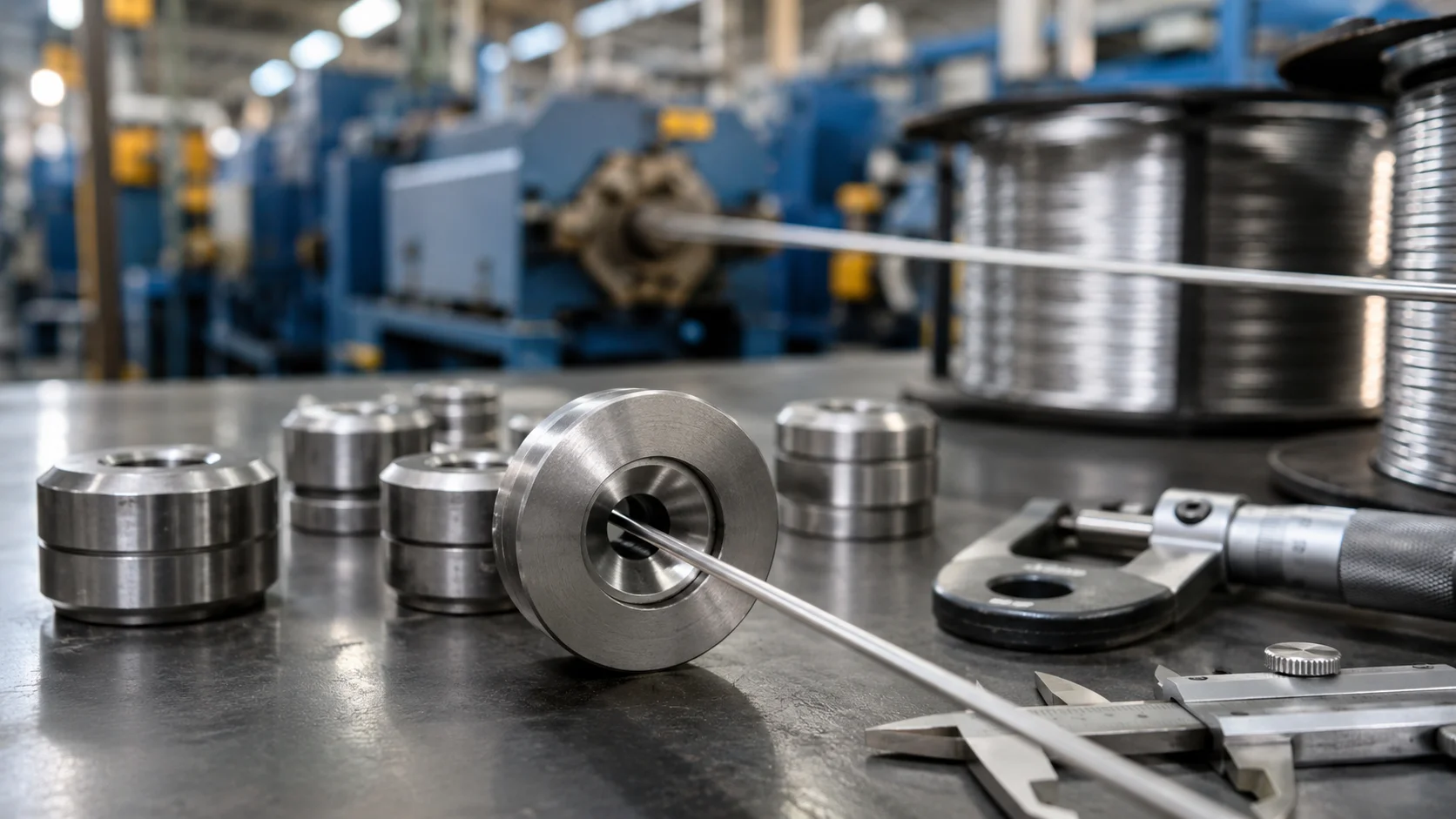
Wire drawing dies are among the key equipment used in wire drawing production, directly affecting production quality and process efficiency. Choosing the right die is essential to shape the wire according to the required size, surface quality, and intended application.
Price and Size Alone Are Not Enough When Choosing a Wire Drawing Die
When purchasing a wire drawing die, looking only at the size or price is often not enough. The wire material, production line structure, target tolerance, surface expectation, production volume, and die material should all be evaluated together.
Field experience shows that a correctly selected wire drawing die helps achieve more stable results during production. This contributes positively to both product quality and production planning.
The correct die selection should be made for copper, aluminum, steel, stainless steel, precious metals, and special alloys.
The target diameter, acceptable measurement range, and surface expectation should be clarified before placing an order.
A supplier with production experience can offer technical solutions tailored to the need, beyond standard product supply.
The Material of the Wire to Be Drawn Should Be Clearly Defined
The first step in selecting a wire drawing die is to correctly define the material of the wire to be drawn. Copper, aluminum, steel, stainless steel, gold, silver, and different alloy wires each have different characteristics. The material’s hardness, surface sensitivity, behavior during drawing, and production purpose should be considered when selecting the die.
For example, in highly conductive metals such as copper and aluminum, surface quality and dimensional stability become more prominent. In harder or more abrasive materials, die durability may become more important. In jewelry and precision wire production, dimensional accuracy, surface smoothness, and workmanship quality become more decisive.
At this point, instead of specifying only the wire diameter, the material of the wire and its intended use should also be shared. This makes it possible to determine the required die type more accurately.
| Wire Material | Main Evaluation Point | Point to Consider During Purchasing |
|---|---|---|
| Copper and Aluminum | Surface quality, dimensional stability, and conductivity expectations | The target diameter, surface expectation, and production continuity should be clearly shared. |
| Steel and Stainless Steel | Durability, wear resistance, and production line compatibility | Material hardness, drawing steps, and tolerance expectations should be evaluated. |
| Gold, Silver, and Precious Metals | Precision size, smooth surface, and workmanship quality | Fine dimensions, special surface requirements, and precision production criteria should be specified. |
| Special Alloys | Application-specific technical requirements | Sharing samples, technical drawings, or current product information can be beneficial. |
Die Internal Geometry Affects Production Performance
Internal geometry is one of the important factors affecting the performance of wire drawing dies. The entrance zone, reduction area, bearing area, and exit form inside the die should work in harmony. This structure helps the wire pass through the die in a controlled and balanced manner.
Each production line may have different drawing steps and expectations. Therefore, the die geometry should be suitable for the line to be used, the material to be drawn, and the target size. Especially in precision production, correctly prepared internal form provides important advantages in terms of dimensional stability and surface quality.
Helps guide the wire into the die in a controlled manner.
Supports the balanced shaping of the wire toward the target size.
Important for dimensional stability and final diameter control.
Surface Quality Affects the Final Application of the Product
In the wire drawing process, surface quality is highly important for the final application of the product. In sectors such as electrical, cable, jewelry, automotive, machinery, fasteners, and special metal processing, a smooth wire surface may also affect subsequent process steps.
Proper processing of the die’s internal surface and good polishing quality contribute to obtaining a smoother wire surface. This becomes even more important in fine wire drawing, precious metal processing, and high-precision production.
Therefore, the targeted surface quality should be clearly specified during the purchasing process. The product should be evaluated not only according to diameter information, but also according to the production quality expectation.
Die Material Should Be Selected According to the Application
The material used in wire drawing dies is also an important part of the selection process. Tungsten carbide, PCD, natural diamond, SSCD, and different special materials offer various advantages depending on the application.
| Die Material | Main Feature | Possible Application Area |
|---|---|---|
| Tungsten Carbide | Robust structure and wide application range | Can be preferred in many industrial wire drawing applications. |
| PCD | High production continuity and wear resistance | Can provide advantages in continuously operating lines and high-volume production applications. |
| Natural Diamond | Precision production and special surface expectations | Can be considered for fine dimensions, precious metal processing, and applications requiring special precision. |
| SSCD and Special Materials | Application-specific performance expectations | Can be evaluated according to special alloys, precise diameter transitions, and technical requirements. |
The key point is to understand that the same die type may not be suitable for every production process. The most suitable die material should be selected by evaluating production volume, wire material, target diameter, tolerance expectation, and application area together.
Tolerance Information Should Be Clarified Before Ordering
When purchasing a wire drawing die, tolerance information should be clearly defined. The target diameter of the wire to be produced, the acceptable measurement range, and, if necessary, roundness expectations should be clarified before ordering.
Standard tolerances may be sufficient in some production processes, while more precise dimensional expectations may arise in certain industries. Especially in coating, winding, welding, fastener, precision mechanical part, or precious metal production, even small dimensional differences can become important.
For this reason, during the purchasing stage, the question “which size?” should be evaluated together with “which tolerance?”. Clear tolerance information helps the product be prepared more appropriately for its production purpose.
Production Volume Directly Affects Die Selection
Production volume is another important factor to consider in die selection. Low-volume production, sample production, periodic production, or continuously operating high-capacity lines do not have the same needs.
In continuously operating lines, service life, dimensional stability, and maintenance intervals become more important. In lower-volume or special production processes, application-specific flexibility and correct material selection may become more prominent.
Therefore, when discussing requirements with the supplier, it is useful to provide information about daily, weekly, or monthly production quantities. When production volume is known, the die type and material to be used can be evaluated more accurately.
Repair and Maintenance Options Provide Long-Term Advantages
Repair and maintenance possibilities should also be considered when selecting a wire drawing die. After a certain period of use, some dies can be evaluated through repolishing, size renewal, or technical maintenance processes. This can provide long-term advantages for businesses, especially in products such as PCD, natural diamond, and tungsten carbide dies.
During the purchasing process, it is important to consider not only the first use of the product but also how it will be supported throughout its service life. Working with a company experienced in production and repair makes it easier to receive technical evaluation and solution support when needed.
The Supplier’s Technical Knowledge and Production Experience Should Be Evaluated
Another important point when buying a wire drawing die is the supplier’s technical knowledge and production experience. Die selection is often not a process that can be carried out only with catalog information. The wire material, production step, target size, tolerance, and surface expectation should be evaluated together.
An experienced supplier can understand the customer’s needs and provide guidance on the correct die type. When necessary, special-size or special-geometry solutions can also be offered instead of standard products. This approach contributes to more efficient production planning.
Technical consultancy becomes even more important especially in special-section wire production, precise diameter transitions, high surface expectations, or production with different alloys. Therefore, during the purchasing process, not only product supply but also technical support capability should be evaluated.
Information to Prepare Before Ordering a Wire Drawing Die
Before placing an order for a wire drawing die, preparing certain information makes the process easier. The wire material, inlet diameter, target outlet diameter, production steps, required tolerance, surface expectation, production volume, machine type to be used, and any special requests should be shared with the supplier.
With this information, the need can be understood more clearly and the appropriate die selection can be made more accurately. Especially in custom production, sharing technical drawings, samples, or current product information can also be useful.
- Material of the wire to be drawn
- Inlet diameter and target outlet diameter
- Production steps and drawing plan
- Required tolerance and surface quality
- Daily, weekly, or monthly production volume
- Machine type to be used
- Special geometry, special section, or technical drawing information, if available
Total Benefit Should Be Considered When Evaluating Price
Price is, of course, an important criterion in purchasing decisions. However, for equipment such as wire drawing dies that directly affect the production process, it is more accurate to evaluate the total benefit. Service life, dimensional stability, suitability for production expectations, maintenance options, and technical support should be considered together with the price.
A correctly selected die enables a more controlled production process. For businesses, the important point is not only to supply the product, but also to determine a solution that is suitable for production targets and provides efficient results in the long term.
Conclusion: The Right Wire Drawing Die Adds Value to the Production Process
In conclusion, when purchasing a wire drawing die, material type, die geometry, surface quality, tolerance expectation, production volume, application area, and the supplier’s technical experience should be evaluated together. These criteria contribute to healthier and more sustainable results in the production process.
Teknik Hadde offers solutions for the needs of different industries with its experience in wire drawing die production, repair, and technical solutions. It provides technical support for selecting the right die for wire drawing processes involving copper, aluminum, steel, precious metals, and special alloys.
Get Technical Support for Your Wire Drawing Die Needs
For your wire drawing die requirements, you can contact Teknik Hadde to receive information about solutions suitable for your production conditions and target dimensions.
Contact Teknik HaddeFrequently Asked Questions
What should be considered first when selecting a wire drawing die?
First, the material of the wire to be drawn, inlet diameter, target outlet diameter, tolerance expectation, and intended use should be determined. This information makes it easier to select the correct die type.
Can the same die be used for every wire material?
The same die type may not be suitable for every wire material. Copper, aluminum, steel, stainless steel, precious metals, and special alloys have different production expectations, so the die material and internal geometry should be evaluated accordingly.
Why is surface quality important in a wire drawing die?
Surface quality can affect the subsequent processing steps and final application area of the wire. In fine wire drawing, precious metal processing, cable, automotive, and precision production, die internal surface and polishing quality become more important.
How should a choice be made between PCD, tungsten carbide, and natural diamond dies?
The selection should be made according to production volume, wire material, target diameter, tolerance expectation, and surface quality. Tungsten carbide offers a wide application range, while PCD can be considered for applications requiring high production continuity and wear resistance. Natural diamond dies can be preferred for fine dimensions and special surface expectations.
What information should be given to the supplier before ordering?
Wire material, inlet diameter, target outlet diameter, production steps, tolerance expectation, surface quality, production volume, machine type to be used, and any special requests should be shared with the supplier.